


How to Stop Balayage Turning Brassy — Causes, Fixes and Prevention
If your balayage has drifted orange, yellow or generally warmer than the day you left the salon, nothing has gone wrong. Brassiness is the natural behaviour of dark hair that has been lightened, and it is one of the most common reasons people return to a colour salon.
Understanding why it happens makes it much easier to fix — and to slow it down next time. For service details, see our balayage and hair colouring services.
KEY TAKEAWAYS
— Brassiness is warm pigment being exposed, not colour changing into a new shade.
— Naturally dark hair holds more underlying warmth, so it surfaces sooner on Asian hair.
— Toner fading is usually the trigger, not the lightening itself.
— Purple counteracts yellow; blue counteracts orange. Using the wrong one achieves very little.
— At-home products can help maintain a cool tone, but cannot correct significant warmth- you’ll need a salon toner or gloss to correct it.
Why Balayage Turns Brassy
Every head of hair contains warm pigment underneath its surface colour, and darker hair contains a great deal more of it. That warmth is not added during colouring — it is already there, sitting beneath the natural shade.
Lightening removes dark pigment in stages, and as it does, the warm pigment underneath is revealed in a predictable order: red first, then orange, then yellow. Where your hair stops on that scale depends on how much lift was needed to reach your target shade.
At the end of the service, toner is applied to neutralise that exposed warmth and create the cool tone you left with. But toner is semi-permanent by design — it sits on the surface of the hair rather than inside it, and washes out gradually.
So when toner fades, the warmth that was always underneath becomes visible again. Your hair is not turning a new colour — it is returning to the level it was lifted to. That single idea explains most brassiness, and it is why toning is usually the fix rather than more lightening.
Why It Shows Faster on Dark Asian Hair
If your colour seems to go warm faster than a friend’s, your starting point is usually the reason.
- More underlying warmth to begin with — darker bases carry a higher concentration of red and orange pigment, so there is more of it to surface.
- More lift required — reaching a light, cool result from a dark base means more lightening, which exposes more warmth in the process.
- Previously coloured lengths lift unevenly — older colour, box dye or earlier lightening can cause warmth to appear patchily rather than evenly.
- Cooler targets sit further from your natural base — the greater the difference between your hair’s natural warmth and your chosen cool tone, the more noticeable the colour change becomes as the toner fades.
None of this makes cool tones off-limits on dark hair. It does mean the tone needs maintaining rather than assumed to hold on its own.
Is It Brassiness, or Is the Colour Just Fading?
These two problems look similar in the mirror but need different fixes, so it is worth telling them apart before booking anything.
| Sign | Brassiness | Fading |
|---|---|---|
| Colour shift | Warmer — orange, yellow or gold | Lighter, duller, less saturated |
| Cause | Toner has washed out, exposing warmth underneath | Pigment loss from washing, sun exposure and time. |
| Where it shows | In the lightened sections, usually mid-lengths and ends | Fairly evenly across all coloured hair |
| Usual fix | Toner or gloss to neutralise the warmth | Colour refresh or gloss to restore pigment |
The practical difference matters. Brassiness generally needs neutralising, while fading generally needs re-pigmenting. Booking the wrong service means paying for an appointment that does not solve the problem you actually have.
How to Correct Brassy Balayage
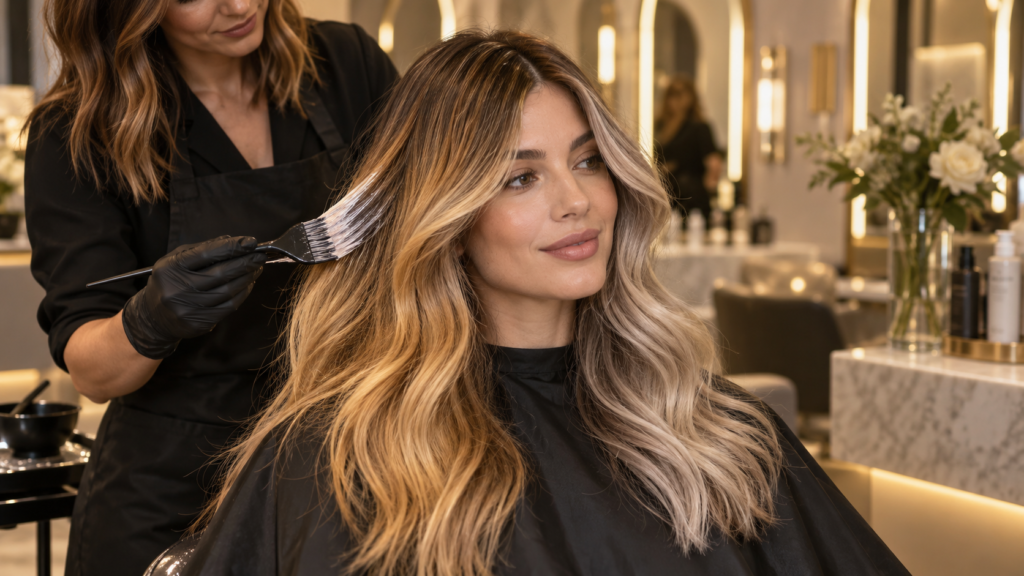
There are two realistic routes, and which one you need depends on how far the tone has drifted.
Salon toner or gloss
This is the standard correction and the fastest one. A toner deposits cool pigment to neutralise the warmth without lightening the hair further, and a gloss adds shine at the same time. It is a much shorter appointment than the original colour service. If you are unsure which service you need, our professional toning and colour services start with an assessment of your current tone.
Purple or blue shampoo at home
Both work on the same principle — placing an opposing colour against the unwanted one to cancel it out — but they are not interchangeable, and this is where most people go wrong.
- Purple counteracts yellow. Use it when your hair has lifted to a pale, blonde level and the unwanted tone reads as yellow or gold.
- Blue counteracts orange. Use it when your hair sits at a brown or dark blonde level and the unwanted tone reads as orange or copper.
Because dark hair usually lifts to the orange range rather than the yellow range, blue shampoo is often the more useful choice for balayage on a naturally dark base — even though purple shampoo is the one more widely marketed. If you are unsure, look at your hair in natural daylight and identify whether the warmth reads more orange or more yellow.
When home products are not enough
Toning shampoos maintain a cool tone. They do not correct one that has already drifted significantly. If the warmth is strong, uneven across sections, or your hair was lifted several levels, a salon toner will achieve in one appointment what months of shampoo could not.
What not to do
- Avoid box toners — they cannot account for how your particular hair is lifted, and uneven porosity often produces patchy results.
- Do not overuse purple shampoo — leaving it on too long or using it daily can deposit a dull violet cast, particularly on porous ends.
- Do not lighten further to remove warmth — additional lifting exposes more warm pigment, not less, and adds unnecessary stress to the hair.
Where the warmth is noticeably uneven, an in-person assessment is worth the trip — patchiness usually reflects porosity variation rather than toner fade alone, and that changes how the correction should be approached. If your hair has been lightened repeatedly, it is worth discussing our hair repair and treatment options at the same appointment.
Not sure whether you need a toner or a full refresh? Book a colour consultation with Full House Salon.
Keeping Brassiness Away
Most of what protects your tone is standard colour care — sulphate-free products, cooler water, UV protection and rinsing after swimming — all of which is covered in our hair colour aftercare guide, along with colour maintenance and touch-up timing.
Two habits are specific to brassiness. Use a purple or blue shampoo weekly rather than daily, so you are maintaining tone rather than over-depositing. And book a gloss or toner refresh before the warmth becomes obvious rather than after it has fully surfaced.
Maintaining a cool tone is considerably easier than correcting one.
Why Consider Full House Salon for Colour Correction
- Consultation and tone assessment — we look at your current tone and colour history before recommending anything.
- Toning and gloss services — correction without unnecessary additional lightening.
- Home product guidance — advice on whether purple or blue suits your shade, and how often to use it.
- Located in Tampines One, convenient for regular tone refreshes.
Final Recommendation
Brassiness is expected chemistry on dark hair, not a fault in the colour or the work that was done. The warmth was always underneath; the toner was holding it back, and the toner fades by design.
That is why the fix is almost always toning rather than more lightening. Establish first whether you are seeing brassiness or ordinary fading, then match the service to the problem — a toner for warmth, a colour refresh for dullness.
If your tone drifts warm faster than you would like, mention it at your next appointment. A slightly cooler target shade, or a planned gloss between colour services, often solves the pattern for good.
FAQs About Brassy Balayage
These FAQs cover the questions we are asked most often when colour has drifted warm.
Why did my balayage turn orange?
Orange is the warm pigment that sits underneath dark hair, exposed during lightening. Toner neutralises it at the appointment, but toner washes out over time. When it fades, that underlying orange becomes visible again — the hair has not changed colour, it has returned to its lifted level.
What is the difference between purple and blue shampoo?
Purple counteracts yellow tones, so it suits hair lifted to a pale blonde level. Blue counteracts orange tones, so it suits hair at a brown or dark blonde level. Since dark hair usually lifts to orange rather than yellow, blue is often the better choice.
Does purple shampoo fix brassy hair?
It maintains a cool tone rather than correcting one that has already drifted. If the warmth is mild and reads yellow, purple shampoo helps. Strong, uneven or orange-toned brassiness needs a salon toner — no shampoo will neutralise it fully.
Can brassiness be fixed without re-bleaching?
Yes, and it usually should be. Toner and gloss deposit cool pigment to neutralise warmth without lightening the hair further. Additional lightening actually exposes more warm pigment, so it tends to worsen the problem rather than solve it.
How soon after balayage can I get a toner?
A toner can generally be applied once the hair has settled after the colour service, and many people book one as a scheduled refresh rather than waiting for visible warmth. The right timing depends on your hair’s condition, so confirm it with your stylist.
Does brassiness mean my colourist made a mistake?
No. Brassiness is the expected behaviour of lightened dark hair as toner fades, not a sign of poor work. It is one of the most common reasons for a return visit, and a straightforward toning appointment usually resolves it.
Ready to cool your colour back down? Explore our balayage and hair colouring services, or book an appointment with our team at Full House Salon in Tampines for a tone assessment and toning consultation.
WhatsApp us