


Hair Rebonding Aftercare: How to Maintain Your Results and Manage Regrowth
Rebonding permanently straightens the hair it treats, which means the result itself does not fade. What changes is everything around it: how the treated lengths are cared for in the days afterwards, and how new growth behaves as it comes through.
Getting both right is the difference between a result that looks intentional for months and one that looks grown out within weeks. This guide separates the critical first 72 hours from the ongoing care and regrowth management that follows.
For service details, see our hair rebonding service.
KEY TAKEAWAYS
— The first 48–72 hours set the result. Bends, ties or moisture during this window can create permanent kinks in freshly rebonded hair.
— Prioritise moisture, not protein. Rebonding leaves hair protein-saturated, so aftercare should focus on hydration, sulphate-free products and weekly masks.
— The result does not fade. Treated lengths stay straight because the hair’s structure has been permanently altered. What changes is new growth arriving with its natural texture.
— The regrowth line is normal. The visible line where straight lengths meet natural roots is expected, and manageable with styling and well-timed touch-ups.
— Root touch-up over full-head. Maintenance should treat new growth only, to avoid overlapping chemical processing on already-straightened hair.
The First 72 Hours: Why This Window Matters Most
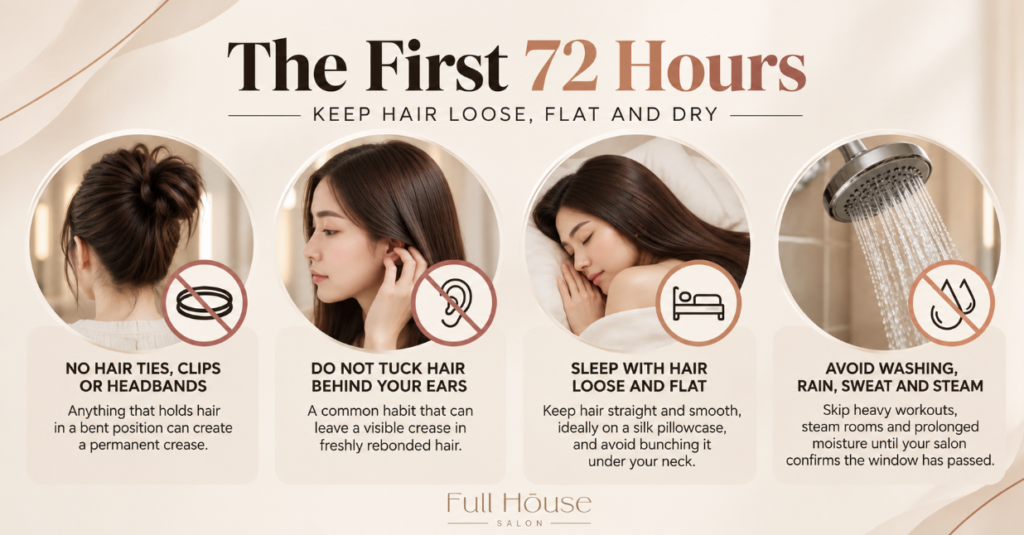
These are the most important hours of the entire process. The chemical bonds that hold your hair’s shape have been broken and reformed, and they are still settling — so anything that bends the hair now can set into the new structure permanently. That is why the rules here are a little stricter than ordinary aftercare, and why breaking them usually cannot be undone at home.
- No hair ties, clips, pins or headbands. Anything that holds hair in a bent position can create a permanent crease. Do not push sunglasses onto your head either.
- Do not tuck hair behind your ears. The most commonly missed habit, and one that sets a visible crease into freshly rebonded hair.
- Sleep with hair loose and flat. Keep it straight and smooth, ideally against a silk pillowcase, and avoid bunching it under your neck.
- Avoid washing, rain, sweat and steam. Skip heavy workouts and steam rooms until your salon confirms the window has passed.
- If hair does get kinked or wet, do not fix it yourself. A flat iron or styling product at this stage usually makes the problem permanent. Contact the salon instead — early correction is often possible.
Washing Rebonded Hair
The wait exists because water and shampoo swell hair cuticles while natural bonds stabilize. Washing too early softens the straight effect or causes uneven texture. Follow your stylist’s first-wash timing—72 hours for coarse hair, 48 for fine hair to protect results.
When you do wash your hair:
- Use cool or lukewarm water—never hot water, which lifts cuticles and can cause frizz on chemically straightened hair.
- Handle gently. Minimise scalp scratching and support lengths with your hands to reduce stretching. Use a wide-tooth comb on wet hair to prevent breakage.
- Choose the right shampoo and conditioner. Opt for sulfate-free products labelled for chemically treated hair. Harsh clarifiers strip moisture and can compromise the straight shape.
- Apply conditioner to mid-lengths and ends after each wash to maintain softness without weighing down roots.
- Moisture over protein. Rebonding leaves hair protein-saturated. Heavy protein masks too soon can make hair brittle. Use hydrating masks weekly.
- Drying habits. Pat hair with a towel, don’t rub. Let hair dry straight—air-dry or blow dry on low heat, directing airflow down the shaft.
Everyday Maintenance
Beyond the first wash, rebonded hair care is about consistency rather than complexity — keeping hair hydrated and handling it gently enough that the straight finish lasts.
- Weekly moisture routine. Condition at every wash, deep-condition weekly, and use a leave-in or light serum on mid-lengths between washes.
- Limit heat styling. Rebonded hair is already straight, so most heat use is unnecessary. When you do use heat, keep it low and always apply a protectant.
- Humidity and sweat at the root line. In Singapore’s climate, new growth reacts to humidity long before treated lengths do — which is why the regrowth line shows at the hairline and parting first.
- Air-conditioning. Long hours in air-conditioning dry chemically treated hair. A lightweight oil or leave-in on the ends helps offset it.
- Avoid tight ties for the first month. Even after the initial window, tight elastics can leave marks in rebonded hair. Loose, soft ties only.
- Regular trims. Trimming every six to eight weeks keeps the ends from looking thin and the overall shape looking deliberate.
Understanding the Regrowth Line
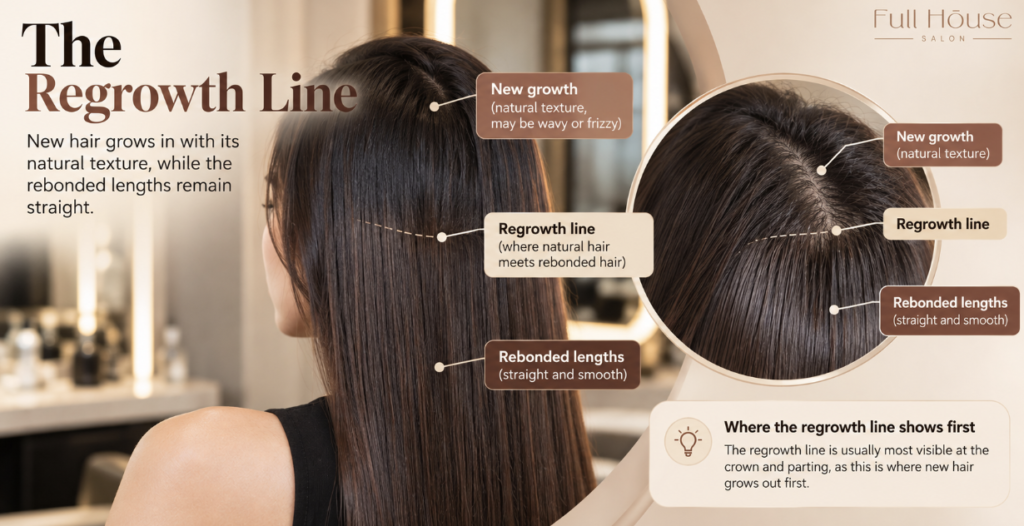
Rebonding only affects hair that was on your head at the time of treatment. It cannot change hair that has not grown yet — so as new hair comes through at roughly a centimetre a month, it arrives with your natural texture.
That creates a visible line where straight treated lengths meet natural-texture roots. It shows first at the crown, hairline and parting, and the more wavy or curly your natural texture is, the sharper the contrast looks. This is expected and it is the single thing that determines when your next appointment should be.
Rebonding and keratin behave differently as they grow out, which is worth knowing if you have had both:
|
Rebonding |
|
||
|---|---|---|---|---|
| Colour shift | A defined line between straight lengths and natural-texture roots | A gradual softening, with treated lengths easing back toward their natural texture | ||
| Root contrast | Clear texture change at the root zone | Softer, blended transition with no hard line | ||
| What maintenance looks like | Root touch-up on new growth only | Re-treatment of the lengths as smoothing fades |
If you are weighing up the two treatments rather than maintaining one, our guide to how rebonding and keratin differ covers the full comparison.
Root Touch-Up or Full Rebonding?
When the line becomes noticeable, the question is not only when to return but what to ask for — and the answer is almost always a root touch-up rather than a full head.
- Root touch-up as the default. It treats only new growth from the scalp down a few centimetres, leaving already-straightened lengths untouched.
- Why full-head repeats cause problems. Rebonding the full length again overlaps strong chemicals onto already-processed hair, thinning the ends and leaving them prone to breakage.
- How overlap damage happens. Product or heat strays past the root zone, particularly at the nape and hairline, weakening those sections over time. It is difficult to reverse.
- Signs it is time. A clear texture change along your parting, roots puffing in humidity while ends stay flat, or more effort needed to flatten the crown each morning.
- Condition over calendar. Judge timing by how your hair looks and feels rather than a fixed date. If it has been bleached or is showing damage, consult before any touch-up.
Not sure whether you need a root touch-up? Book a consultation with Full House Salon.
Styling Through the Grow-Out Phase
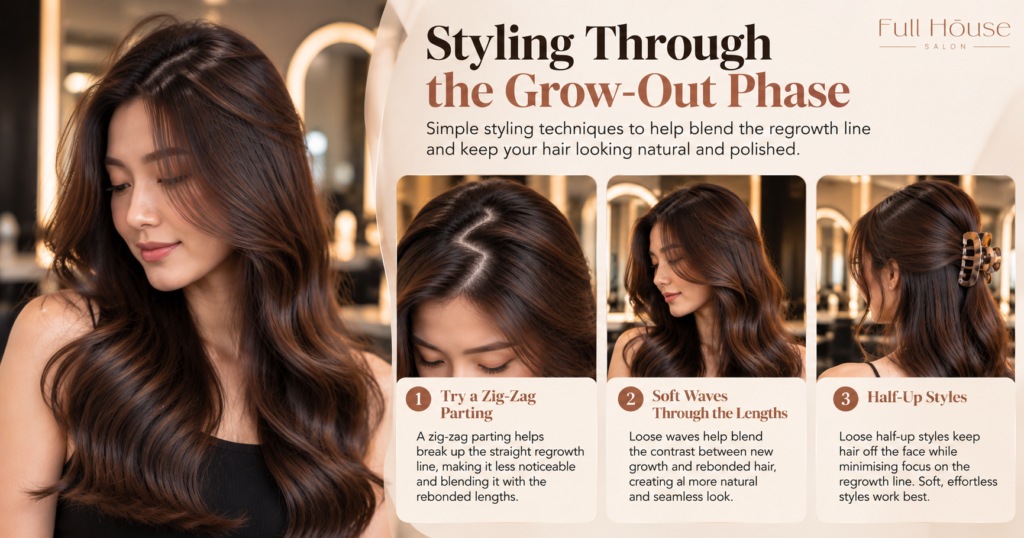
Between touch-ups, a few adjustments make the transition look intentional.
- Soften the contrast. Add loose waves through the mid-lengths and ends with low heat and a protectant — movement makes the root texture read as part of the style.
- Adjust your parting. Shifting the part, or using a soft zig-zag rather than a sharp line, disguises the contrast where it shows most.
- Go easy on the roots. Straightening regrowth daily at high heat causes breakage exactly along the line where the two textures meet. A light blow-dry with a paddle brush is enough.
- Choose cuts that blend. Soft layers and face-framing pieces disguise a texture change far better than a blunt cut.
- Transitioning away. If you decide to stop rebonding altogether, layered cuts combined with moisture-focused treatments let you grow it out without an awkward in-between phase.
Colouring Rebonded Hair
Colour and rebonding are both chemical services, so order and spacing matter. Rebonding first, then colour, is the usual sequence, with a gap between the two so hair is not processed twice in quick succession. How long that gap should be depends on your hair’s condition, so confirm it with your stylist rather than booking both close together — and note that hair which has been bleached or is already compromised may not suit both services at all.
For maintaining colour once it is done, see our hair colour aftercare guide.
When to Speak to Your Stylist
A few signs warrant a call rather than a home fix:
- Snapping or white dots along the lengths, or shedding well beyond normal.
- Sections that will not stay straight, or kinks that never settled after the first window.
- Persistent scalp irritation, flaking or sensitivity after the service.
- A sharply defined line appearing within a few weeks, which can indicate underprocessing.
- Hair that feels gummy or rubbery when wet — a sign of overprocessing that needs professional assessment, not home experiments.
Where condition is the concern rather than the rebonding itself, our hair repair and treatment options are the better starting point.
Why Consider Full House Salon for Rebonding Maintenance
- Pre-touch-up consultation. We assess hair condition, previous chemical services and regrowth patterns before recommending anything.
- Root-focused approach. We prioritise carefully targeted root rebonding over unnecessary full-head processing.
- Personalised aftercare. You leave with specific guidance on products, trim timing and when to book next.
- Located in Tampines at Tampines One, convenient for regular maintenance appointments.
To compare the systems we work with, see our guide to the types of rebonding treatments, or book rebonding at our Tampines salon.
Final Recommendation
The first 72 hours lock in the shape. Protect that window carefully — most of what goes wrong with rebonded hair happens in those three days, and cannot be corrected at home afterwards.
After that the routine is simple: sulphate-free products, weekly hydration, minimal heat and gentle handling. Rebonded hair needs moisture far more than protein, and that single distinction prevents most of the dryness people report.
Regrowth is a scheduling question rather than a problem. The line will appear, and the answer is a well-timed root touch-up rather than repeating the full head. If you are unsure about your timing or your hair’s condition, a short consultation can settle any doubts before any damage is done.
FAQs About Rebonding Aftercare
These FAQs cover the questions we are asked most often after a rebonding appointment.
When can I wash my hair after rebonding?
Wait 48 to 72 hours, and follow the timing your stylist gives you — it varies with hair type and the system used. Washing earlier disrupts bonds that are still settling, which can soften the straight effect or leave the texture uneven. Use cool or lukewarm water for that first wash.
Can I tie my hair up after rebonding?
Not during the first 48 to 72 hours, when a tie can set a permanent crease. After that, use soft, loose ties only, and keep hair down as much as you can for the first month while the result settles fully.
How do I deal with the line between straight hair and new growth?
Manage it with styling between appointments: soft waves through the lengths, a shifted or zig-zag parting, and a light blow-dry at the roots. Layered cuts blend the two textures well. A root touch-up resets it when the contrast becomes noticeable.
Do I need to rebond my whole head again?
Usually not. Full-head rebonding overlaps strong chemicals onto hair that has already been processed, which thins the ends and causes breakage. A root touch-up treats only the new growth and preserves the lengths you already have.
Why does my rebonded hair feel dry?
Chemical straightening leaves the cuticle more porous, so moisture escapes faster. A moisturising sulphate-free shampoo, weekly deep conditioning and a leave-in product on the ends usually resolves it within a few weeks.
Can I curl rebonded hair?
Occasionally, yes — with low heat and a heat protectant. The curl will not hold as long as it would on untreated hair, and frequent heat styling works against both the condition and the straight finish, so keep it for special occasions.
Ready for a Touch-Up?
Explore our hair rebonding service, or book an appointment with our team at Full House Salon in Tampines for an assessment of your regrowth and hair condition.
Explore Our Hair Rebonding Service Book AppointmentWhatsApp us