


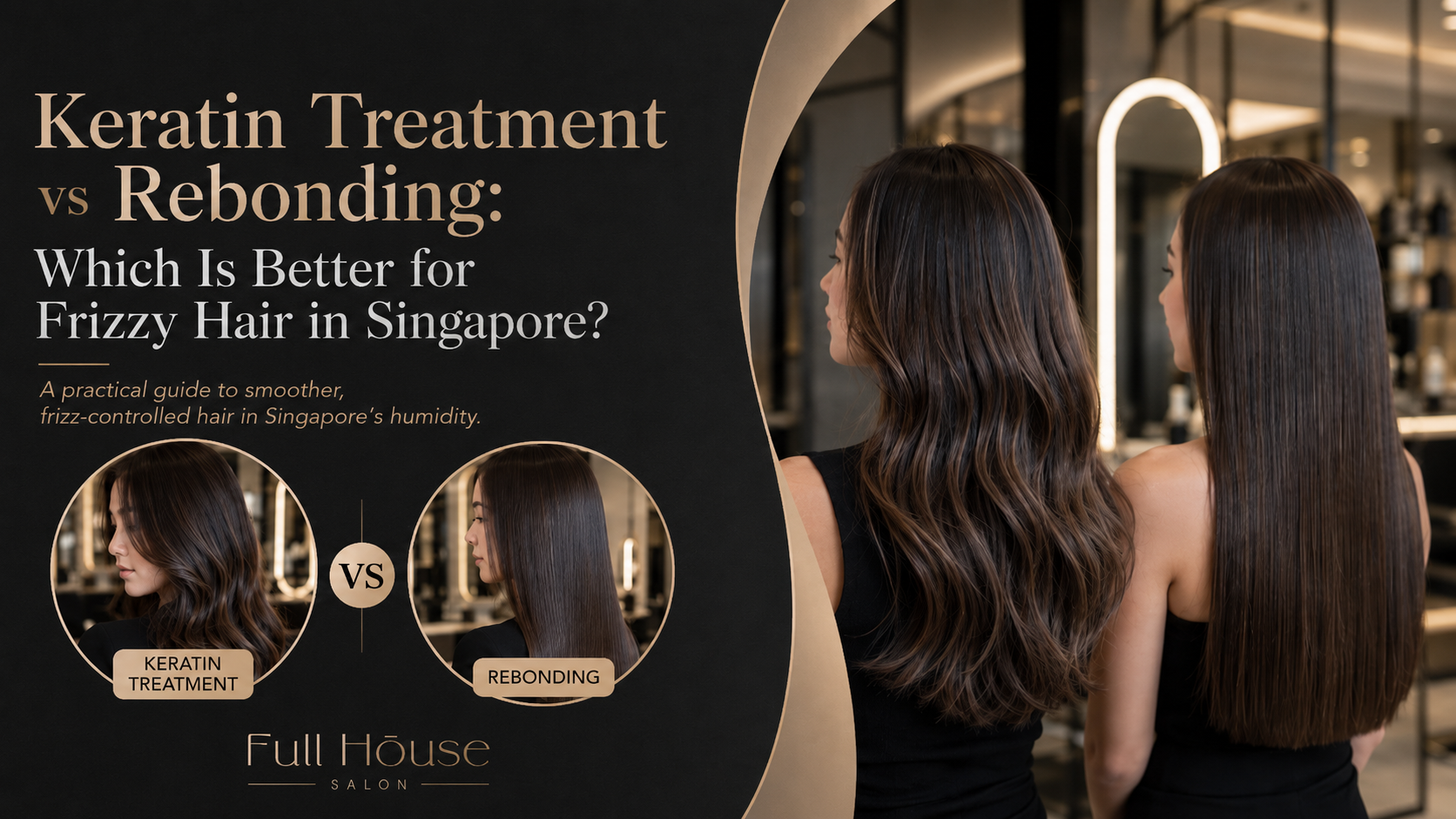
Keratin Treatment vs Rebonding: Which Is Better for Frizzy Hair in Singapore?
Deciding between keratin treatment vs rebonding can feel overwhelming, especially when Singapore’s humidity makes frizzy hair a daily battle. This guide breaks down the key differences, suitability by hair type, and real-world performance of each treatment so you can choose the right option for your hair.
Key Takeaways
- Keratin treatment is best for reducing frizz while keeping natural waves and natural movement; rebonding is best for achieving permanently straight hair with a sleek finish.
- In Singapore’s humidity, keratin provides a softer, more flexible shield that preserves your hair type.
- Keratin treatments typically last between 3 and 6 months, depending on your hair type and the haircare routine you follow, while rebonding can last between 6 and 12 months. However, as new hair grows, both treatments will require regular touch-ups to maintain a consistent look.
- Damaged hair or heavily bleached hair strands need a professional consultation before undergoing either treatment.
- If you are still comparing different treatment options, our guide to hair rebonding treatments explains the common treatment types in more detail.
Why Frizzy Hair Happens in Singapore Humidity
Singapore’s tropical climate and high humidity levels can make hair prone to frizz all year around. When moisture-heavy air surrounds your hair strands, water molecules penetrate the hair shaft, causing it to swell and disrupting the hair cuticle. This is what turns otherwise manageable hair into a frizzy, puffy halo by mid-afternoon.
If your hair’s structure has been compromised by previous chemical treatments, colouring, or bleaching, the cuticle layer lifts more easily, absorbing excess moisture it cannot retain. High-porosity hair frizzes faster and loses styling definition sooner.
Your natural texture matters too. Wavy hair and natural curls tend to show visible frizz because each bend in the strand acts like a mini cuticle lift. Even naturally straight hair can become puffy near the roots. Frequent air-conditioning, UV exposure, and pollution in Singapore strip moisture and degrade keratin, a protein naturally found in hair, roughening the surface further and worsening overall hair health. Understanding this climate context is essential when choosing between keratin and rebonding treatment options for long-lasting, beautiful hair.
What Is Keratin Treatment?
A keratin treatment is a smoothing treatment that helps reduce frizz, soften texture, and improve manageability while keeping more natural movement than rebonding. For full service details, visit our keratin treatment Singapore page.
What Is Rebonding?
Hair rebonding is a permanent treatment that breaks and restructures the hair’s natural bonds, specifically the disulfide bonds, to create completely straight hair. Rebonding permanently alters the hair’s structure and permanently changes the hair’s internal bonds.
Rebonding is best for extremely thick or unruly hair. Soft rebonding aims to deliver a more natural-looking finish with some body preserved, while traditional rebonding produces a pin-straight, glossy result. For a detailed breakdown explore our hair rebonding services page.
Keratin vs Rebonding: Key Differences
Here is a direct comparison of the key differences between keratin treatment vs rebonding for frizzy hair:
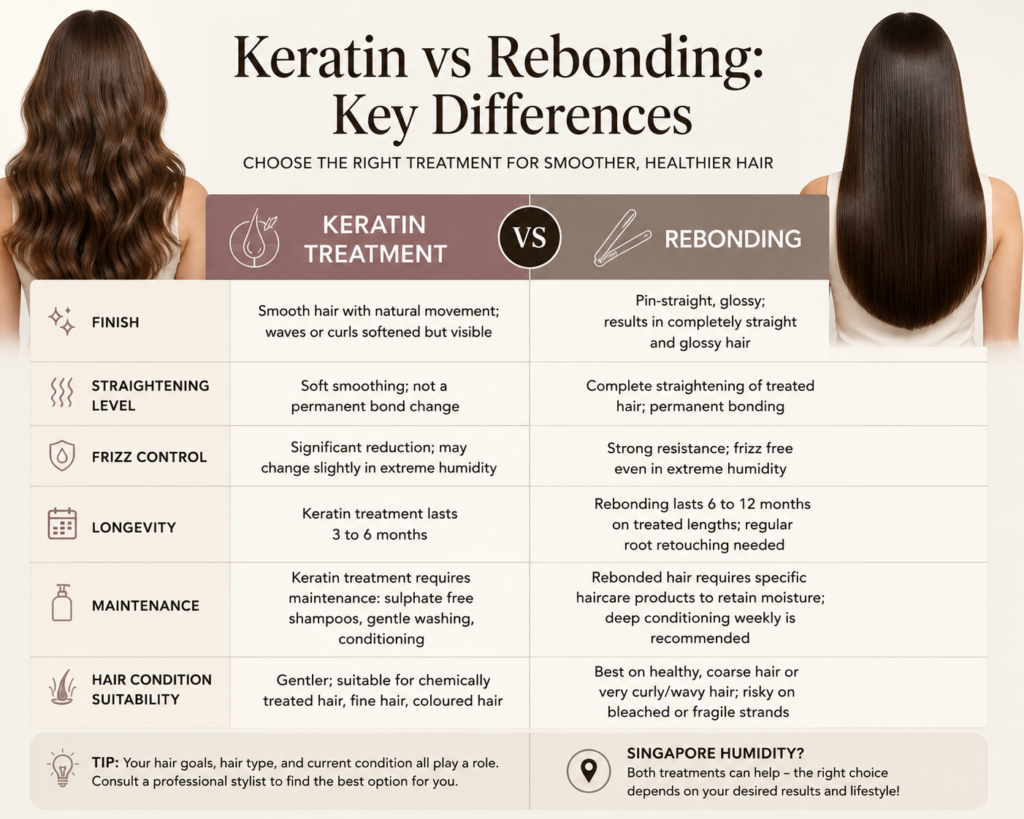
| Feature | Keratin Treatment | Rebonding |
|---|---|---|
| Finish | Smooth hair with natural movement. Waves or curls are softened but remain visible. | Pin-straight, sleek, and glossy with completely straight results. |
| Straightening Level | Provides soft smoothing without permanently changing the hair’s natural bonds. | Permanently straightens the treated hair by restructuring the hair bonds. |
| Frizz Control | Significantly reduces frizz. Minor frizz may appear in extremely humid conditions. | Offers excellent frizz resistance, even in high humidity. |
| Longevity | Typically lasts 3–6 months with proper aftercare. | Typically lasts 6–12 months on treated hair. New growth requires regular root touch-ups. |
| Maintenance | Requires sulphate-free shampoo, gentle washing, and regular conditioning to prolong results. | Requires moisture-rich haircare products and weekly deep conditioning to keep hair healthy. |
| Hair Condition Suitability | Gentler option suitable for coloured, chemically treated, fine, or slightly damaged hair. | Best suited for healthy, coarse, thick, curly, or wavy hair. Not recommended for heavily bleached or fragile hair. |
Which Is Better for Frizzy Hair?
The most suitable treatment depends on your hair goals, hair type, and current hair condition. Keratin treatments are best suited for damaged, frizz-prone, or fine hair that needs smoother, easier-to-manage locks while maintaining its natural shape and movement. Here is a quick decision guide:
- Mild frizz with mostly straight or gently wavy hair → keratin treatment works well to keep the frizz away
- Strong waves or tight natural curls with a goal of straight hair → rebonding tends to give more predictable, lasting results.
- Damaged hair that is over-processed or heavily bleached → consult a stylist before any strong chemical treatments. A suitable treatment plan may involve repair first.
- Wants bone-straight, permanently straight hair with minimal daily effort → rebonding is the better option.
- Wants to keep natural waves but reduce puffiness → keratin treatment suits this better, allowing for styling versatility with natural waves.
Either treatment should be spaced appropriately from additional chemical treatments like hair colour or bleaching to protect hair health. Discuss your natural hair condition and your hair goals with the hair stylist for a more accurate recommendation.
Which Works Better in Singapore's Humid Weather?
Humidity is the main differentiator when comparing rebonding and keratin treatment in Singapore. Rebonding provides a stronger structural shield because the internal natural bonds have been permanently restructured. Rebonded hair resists puffiness and reactive swelling even after a long day outdoors, delivering frizz free results through heavy sweating or sudden rain.
Keratin offers a more flexible barrier. It smooths and seals the hair cuticle, but the effect can wear out with repeated moisture exposure. Hair may still show slight waves in extreme humidity, though it stays noticeably smoother than untreated hair.
Lifestyle considerations in Singapore:
- Commuters and outdoor workers who walk often in heat and rain may benefit more from rebonding’s stronger hold.
- Office workers in air-conditioned environments may find keratin’s natural-looking smoothness a better trade-off for gorgeous hair without a flat finish.
- Frequent washing (daily or every two days due to sweating) accelerates the fade of keratin treatments; rebonding is less sensitive to frequent washing.
Swimming can also weaken keratin-treated hair’s structure, so pool-goers should factor this in.
When to Choose Keratin Instead of Rebonding
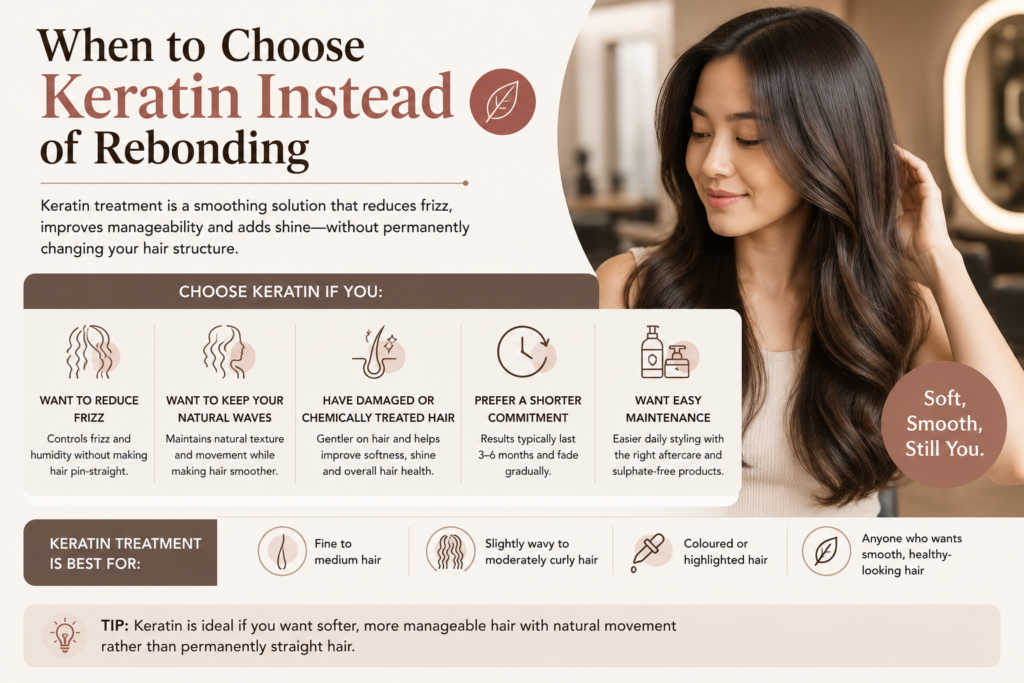
Keratin treatment is generally gentler and the better choice in these scenarios:
- You like your natural waves or curls and only want to reduce volume and frizz. Keratin treatments allow for styling versatility with natural waves.
- Your hair has fine to medium thickness and you want to avoid harsh chemicals.
- You colour your hair regularly. Keratin treatments are gentler and suitable for color-treated hair, reducing the risk of stacking intense additional chemical treatments.
- You want hair that still holds natural movement for styling with heat styling tools, a hair dryer, or blow drying.
Keratin treatments fade progressively, leaving no noticeable regrowth line; just a softer, more gradual transition as new hair emerges.
Some keratin formulas contain formaldehyde, so ask about formaldehyde-free options and ensure proper ventilation during the service. Using an anti frizz serum and leave in conditioner as part of daily care can extend results.
When to Choose Rebonding Instead of Keratin
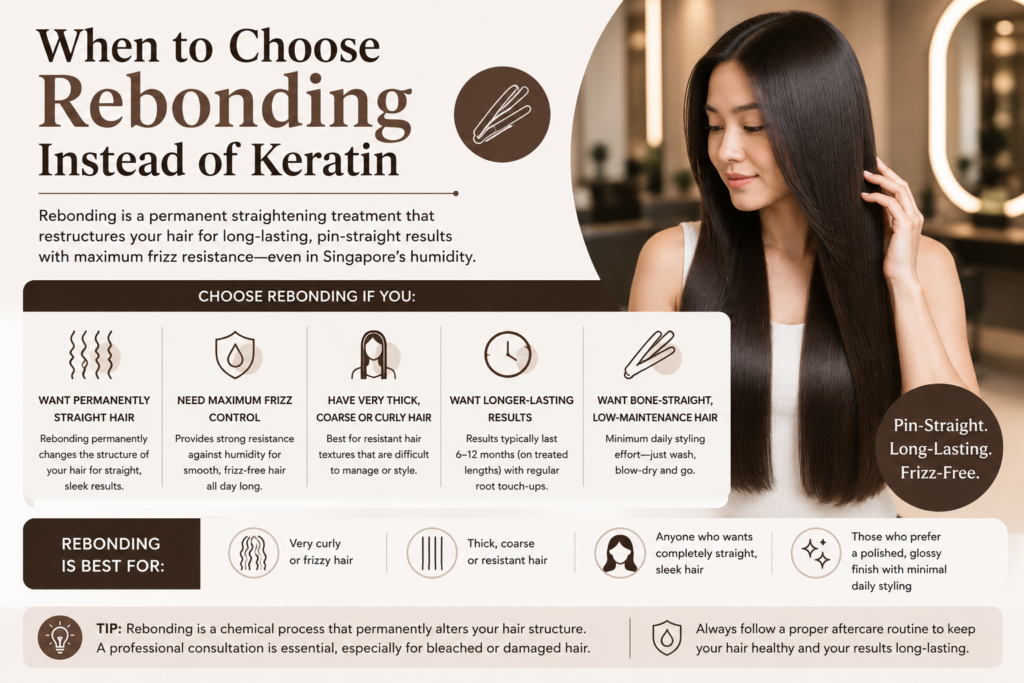
Rebonding is the stronger, more permanent treatment for changing hair texture. It makes more sense when:
- You want permanently straight hair with minimal daily styling. Rebonding offers low daily styling maintenance after treatment, turning unruly hair into sleek, manageable locks.
- You struggle to control frizz in Singapore humidity and prefer a long-lasting result. Rebonding can last up to 12 months on treated lengths.
- You are comfortable with regular touch-ups every 3–6 months as new hair growth appears at the roots.
- Your hair is healthy, with no severe breakage, and your healthy scalp can support a stronger chemical process.
Be aware that rebonding can leave hair dry and prone to breakage if mismanaged. Rebonded hair requires specific haircare products to retain moisture, and you should avoid tying rebonded hair up too soon after treatment. Clients planning future additional chemical treatments like intense bleaching should discuss timing carefully.
For more about the different rebonding methods available, explore the types of hair rebonding. For service details, you can also explore our hair rebonding service.
Final Recommendation
The debate of rebonding vs keratin treatment comes down to choosing between natural-looking smoothness and fully straight hair. Factor in your hair type, current hair condition, and how your hair behaves in Singapore’s relentless humidity.
If you have very damaged or over-processed hair, consider a repair phase such as regular deep conditioning and protein treatments, before committing to either option. Keratin treatment is best for frizz control, flexible hair texture, and maintaining waves or curls. Rebonding is best for long-lasting, sleek, straight hair and maximum frizz control in humid weather.
Book a consultation with an experienced stylist who can assess your hair in person and design a plan that matches your long-term hair goals and hair health. The right treatment is one that works with your hair, not against it, giving you genuinely manageable, beautiful hair for months to come.
FAQ
These FAQs cover practical questions about post treatment care, timing, and long-term hair health that are not fully addressed in the main sections above.
Can I colour my hair after keratin or rebonding?
Wait about 1–2 weeks after a keratin treatment and 2–4 weeks after rebonding before applying hair colour, depending on your hair condition. Doing colour or bleach too soon after strong chemical treatments can cause dryness, breakage, and uneven results. Discuss the order of services with your stylist based on your hair type and goals.
How often can I repeat keratin treatment or rebonding safely?
Keratin treatments are usually repeated every 3 to 6 months, once the smoothing effect has noticeably faded. For rebonding, full-head treatments are rarely recommended more than once or twice a year. Root touch-ups every 3–6 months are more common as hair grows. Regular touch-ups are needed for new hair growth, but overlapping chemical treatments on already-weakened hair increases breakage risk.
Will my natural hair grow back the same after rebonding or keratin?
Both treatments only change the hair shaft that is treated. New hair that grows from the scalp keeps its natural texture. With rebonded hair, a visible line between straight mid-lengths and wavy or curly roots can appear as hair grows out. Keratin treatments leave no visible line of demarcation when growing out, so the transition tends to be softer.
Is either treatment safe for very damaged or bleached hair?
Heavily bleached or weak hair may not tolerate rebonding at all and may need intensive repair first. Keratin treatments can safely be done on fine or damaged hair, but even gentler formulas can be too strong if hair is severely compromised. An in-person strand test and professional consultation are recommended before committing.
How should I care for my hair after keratin or rebonding to keep it healthy?
Use sulphate-free shampoos and conditioners, and apply deep conditioning masks weekly for hydration-this applies to both keratin and rebonded hair. Avoid washing hair for 24–48 hours post-treatment to let the results set. Minimise heat styling tools and always use a heat protectant when heat is unavoidable. Simple habits like gentle towel-drying, sleeping on a silk pillowcase, and using hair masks regularly help maintain the results and protect each hair strand long-term.
WhatsApp us